
How ChatGPT Recommends Local Businesses (And How to Influence It)
ChatGPT uses entity data, reviews, citations, and content authority to recommend local businesses. Learn the exact mechanics behind AI recommendations and how Malaysian businesses can optimise for ChatGPT visibility.
Adam Yong
Founder & Technical SEO Consultant

Many established service businesses in Greater KL and Selangor are noticing a shift in how new clients find them. People are increasingly asking AI for recommendations instead of scrolling through traditional search engines. As a professional service team helping local brands, we regularly hear from business owners who cannot understand why their highly ranked website is invisible to AI.
The reality is that large language models process and retrieve information differently than traditional search. If you are wondering how ChatGPT recommends local businesses (and how to influence it), you are in the right place.
For a broader understanding of AI-driven optimisation, start with our What Is AI SEO pillar guide.
How ChatGPT Actually Works (The Simplified Version)
Before we discuss recommendations, you need a basic understanding of what ChatGPT is doing when someone asks it to suggest a business. A 2026 BrightLocal study found that consumer use of AI for local business recommendations jumped from 6% to an astonishing 45% in just one year. This massive shift means you can no longer afford to ignore how these platforms operate. It is time to adapt.
ChatGPT is a large language model trained on vast amounts of text data. When a user asks “recommend an aircon contractor in Petaling Jaya,” ChatGPT does not search Google in real-time. Instead, it draws on:
- Training data: Text scraped from the web, including directories, review sites, articles, and business listings.
- Entity knowledge: Structured understanding of businesses as entities with attributes like location and services.
- Browsing capability: When enabled, ChatGPT can search the web for current information.
- Pattern recognition: Businesses frequently mentioned in positive, authoritative contexts are more likely to be recommended.
We often see business owners surprised to learn that ChatGPT relies heavily on different data providers than Google. For example, over 70% of the spatial and location data ChatGPT uses for local queries actually comes from Foursquare. These listings are frequently updated and verified by AI agents like Reprompt. If you have not claimed or updated your Foursquare listing recently, you are missing a foundational piece of the AI puzzle.
When ChatGPT uses its browsing feature, it does not look at Google Business Profiles. It actually runs a real-time Bing search and scans the top 20 to 30 web results. This makes your traditional Bing SEO a major factor in whether an AI recommends you.
This is critical to understand. ChatGPT does not rank websites. It recognises entities and assesses confidence in recommending them. The signals that build that confidence are different from SEO ranking factors.
The Five Factors That Drive ChatGPT Recommendations
Based on our analysis of hundreds of ChatGPT recommendation queries across Malaysian business categories, we have identified five primary factors.
Factor 1: Entity Clarity
ChatGPT needs to clearly understand what your business is. This means having a well-defined entity with:
- Business name: Consistently used everywhere.
- Business category: Clearly stated, not vague or overly broad.
- Service area: Explicitly defined.
- Core services: Listed and described clearly.
- Unique differentiators: Features that separate you from competitors.
Businesses with ambiguous identities (those that try to be everything to everyone) rarely get recommended. ChatGPT favours specificity because it allows the model to match the recommendation to the user’s query with higher confidence. Our Local Entity Management service builds this entity foundation systematically across all relevant platforms.
To achieve this clarity, you must implement JSON-LD LocalBusiness schema markup on your website’s homepage. This code acts as a direct digital translator, feeding AI platforms exact details like your official SSM (Suruhanjaya Syarikat Malaysia) registration number, operating hours, and exact geolocation coordinates.
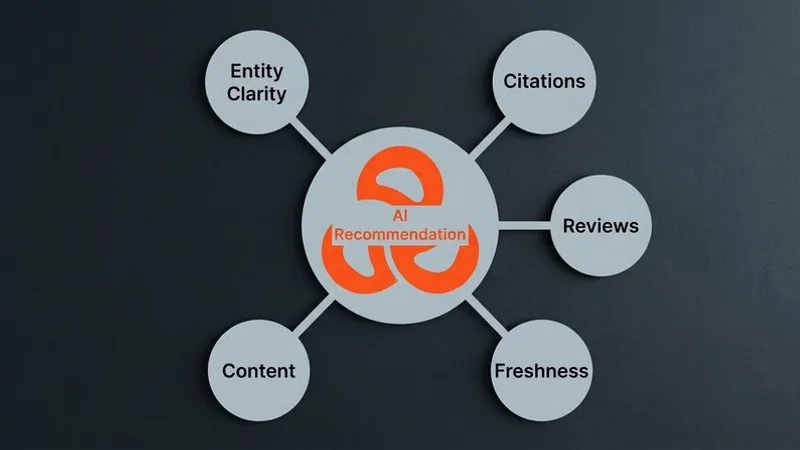
Factor 2: Review Presence and Sentiment
Reviews are one of the strongest signals for AI recommendations. ChatGPT weighs:
- Volume: Businesses with more reviews appear more established.
- Recency: Recent reviews signal an active, current business.
- Sentiment: Consistently positive reviews increase recommendation confidence.
- Specificity: Reviews that mention specific services, staff names, or outcomes carry more weight.
- Platform diversity: Reviews across Google, Facebook, and industry-specific platforms provide stronger signals.
This is not just about Google reviews. AI models are trained on text from multiple review platforms. A business with 200 Google reviews, 50 Facebook reviews, and mentions on industry forums has a much stronger entity footprint than one with 200 reviews on a single platform.
The timeline of your feedback is just as critical as the total star rating. According to the 2026 BrightLocal Consumer Review Survey, 74% of users only care about reviews written in the last three months, and 47% will completely ignore a business with fewer than 20 reviews. ChatGPT mimics this human preference, heavily penalising businesses whose reviews have gone stagnant.
Learn how reviews specifically affect AI recommendations in our detailed guide: Do Google Reviews Affect AI Recommendations?
Factor 3: Citation Consistency
Citations (mentions of your business name, address, and phone number across the web) are a foundational signal. Inconsistencies create confusion for AI models. If your business is listed as “ABC Sdn Bhd” on Google, “ABC Enterprise” on a directory, and “ABC Services” on Facebook, ChatGPT may lack confidence in recommending any of them.
Consistency across these platforms matters most:
- Google Business Profile.
- Major business directories (Yellow Pages, iProperty, Mudah for Malaysia).
- Social media profiles.
- Industry-specific directories.
- Government registrations (SSM for Malaysian businesses).
A common trap we see local clients fall into is failing to update legacy directories after an office relocation. If your current address is in Petaling Jaya but old listings on platforms like Foursquare or Yelp still point to your previous Kuala Lumpur address, ChatGPT’s confidence score plummets. Our Review & Citation Building service audits and corrects citation inconsistencies across all relevant platforms.
Factor 4: Content Authority
ChatGPT gives more weight to businesses that are discussed in authoritative content contexts. This includes:
- Your own website content: Well-structured, informative content about your services.
- Third-party mentions: Articles, listicles, and guides that mention your business.
- Industry publications: Mentions in trade publications or industry blogs.
- Community presence: Active participation in relevant online communities.
- Media coverage: Press mentions and news articles.
Notice that this is different from backlinks. A backlink from a high-authority website helps Google rankings. However, a contextual mention of your business in an authoritative article helps AI recommendation confidence, even without a link.
Getting featured in prominent Malaysian digital publications like Vulcan Post or SAYS provides massive entity validation for local AI searches. These unlinked brand mentions act as digital votes of confidence that language models scrape and store during their training phases. Our Community Presence service and AI Citation Content service build this authority layer specifically for AI platforms.
Factor 5: Content Freshness
This is one of the most underappreciated factors. Data shows that 76.4% of pages cited in AI responses have been updated within the past 30 days. AI platforms strongly favour current, maintained information.
A business whose website has not been updated in two years sends a signal, perhaps unintentionally, that the information may be outdated. Regularly updated content, fresh blog posts, and current service descriptions all contribute to freshness signals.
We recommend implementing the IndexNow protocol on your website to instantly notify search engines and AI crawlers the moment you publish an update. This setup typically involves two quick steps:
- Generating an IndexNow API key for your domain.
- Configuring your website platform to automatically ping Bing whenever a page is published.
While traditional XML sitemaps can take weeks to be crawled, IndexNow pushes your latest service changes or blog posts directly to Bing, which directly feeds ChatGPT’s browsing feature.
What Happens When Someone Asks ChatGPT for a Recommendation
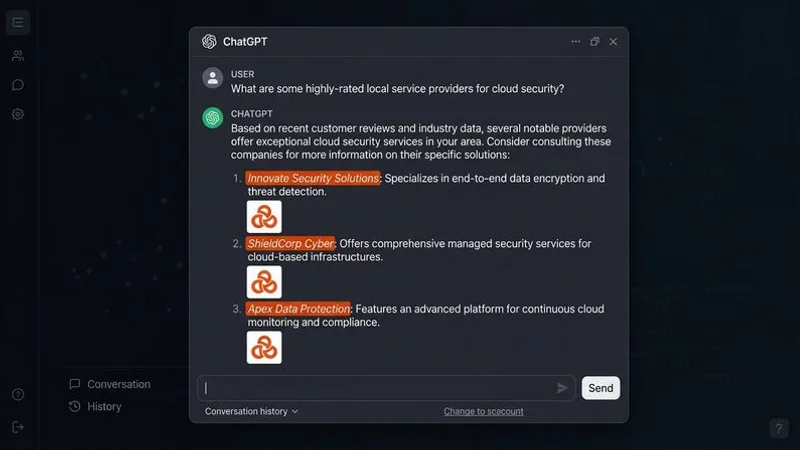
Let us walk through a specific scenario. A user in Kuala Lumpur types:
“Recommend a good dental clinic in Mont Kiara for teeth whitening.”
Here is what ChatGPT processes, which is entirely different from a standard keyword search:
- Query parsing: Identifies the entity type (dental clinic), location (Mont Kiara, KL), and service (teeth whitening).
- Vector database retrieval: Unlike Google matching keywords, ChatGPT uses embedding models to convert your business data into mathematical coordinates. It searches vector databases (like Pinecone or Milvus) for businesses whose meaning aligns with the user’s intent.
- Confidence assessment: For each potential recommendation, assesses how confident it can be based on available data.
- Response generation: Recommends 2-5 clinics it is most confident about, typically including brief descriptions of why each is recommended.
- Qualification: Often adds caveats like “based on available information” or “I recommend checking recent reviews.”
The clinics that get recommended are not necessarily the ones with the best Google rankings. They are the ones with the strongest entity presence in ChatGPT’s training data and accessible web information.
To make this clearer, let us look at how the two systems compare:
| Feature | Traditional Google Local Search | ChatGPT Recommendation Engine |
|---|---|---|
| Primary Data Source | Google Business Profile & Website | Foursquare, Bing Index & Diverse Web Training Data |
| Location Matching | Proximity to searcher (GPS) | Entity association with specific geographic terms |
| Ranking Mechanism | Backlinks & keyword density | Confidence scores & semantic vector similarity |
| Review Impact | Total volume & overall star rating | Contextual sentiment & specific keyword mentions |
Why Your Business Might Not Be Recommended
Based on our AI Visibility Audit work with Malaysian businesses, here are the most common reasons:
Weak Entity Footprint
Your business simply does not have enough presence across the data sources ChatGPT draws from. You might have a website and a Google listing, but if there is minimal presence elsewhere, ChatGPT may not have enough data to confidently recommend you. Recent 2025 data from SparkToro revealed that 54% of AI answer blocks cite at least one Bing-discoverable URL. If your website is not actively indexed in Bing Webmaster Tools, your entity footprint is virtually invisible to ChatGPT’s live browsing feature.
Inconsistent Information
Different platforms show different business names, addresses, or phone numbers. This fragments your entity and reduces AI confidence. A 2025 Business Wire study found that 73% of consumers lose trust if online information is inconsistent. Language models apply the exact same logic. If your SSM registration says one thing and your Facebook page says another, the AI simply drops you from the recommendation pool to avoid giving a bad answer.
Low Review Volume or Quality
Fewer than 20 Google reviews makes it difficult for AI to assess your reputation with confidence. Businesses with 50+ reviews and strong sentiment have a significant advantage. AI platforms also often apply hidden filters based on user behaviour. Since 2026 data shows that 31% of consumers will only use a business with 4.5+ stars, ChatGPT frequently mimics this by automatically filtering out any local business scoring below a 4.0.
Outdated Content
If your website content has not been updated in months, AI platforms may deprioritise your business in favour of competitors with fresher information. We see this frequently with service menus or pricing pages that still show dates from two years ago.
No Structured Data
Without schema markup, AI platforms must work harder to parse your business information. Clean structured data makes it easy for AI to understand and cite your business. Our guide on Schema Markup for AI Search covers this in detail.
How to Optimise for ChatGPT Recommendations
Here is a practical action plan, ordered by impact:
1. Complete and Optimise Your Google Business Profile
GBP is the single most important data source for local AI recommendations. Ensure every field is complete:
- All service categories selected.
- Service area clearly defined.
- Business description comprehensive and keyword-rich.
- Photos updated regularly.
- Posts published weekly.
- Q&A section populated.
Our GBP Optimisation service provides a comprehensive approach to maximising your GBP’s impact on both traditional and AI search.
2. Build Review Volume and Quality
Actively solicit reviews from satisfied customers. Aim for:
- 50+ Google reviews minimum.
- Average rating above 4.5.
- Reviews that mention specific services by name.
- Responses to every review.
- Reviews across multiple platforms (Google, Facebook, industry-specific).
Replying to feedback is heavily weighted by AI. A 2025 BrightLocal survey noted that 88% of consumers are more likely to use a business that responds to all reviews, both positive and negative. AI models scrape these responses to determine if a business is actively managed and customer-focused.
3. Ensure Citation Consistency
Audit all your business listings and ensure NAP consistency. Even small differences matter. Variations like “Jalan” versus “Jln” or “Suite 12-3” versus “12-3” create entity fragmentation. In Malaysia, focus specifically on ensuring your SSM business profile perfectly matches your digital footprint across local directories.
4. Add Comprehensive Schema Markup
Implement LocalBusiness schema with complete service, location, and review data. You should specifically include the areaServed and hasOfferCatalog properties within your JSON-LD code. This gives AI platforms clean, structured data to work with without forcing them to parse paragraphs of text. See our Schema Markup for AI Search guide.
5. Create Entity-Rich Content
Write content that clearly defines your business entity:
- Service pages with comprehensive descriptions.
- About page with company history, team, and credentials.
- FAQ pages with common customer questions and direct answers.
- Location-specific content for your service areas.
6. Build Authoritative Third-Party Mentions
Get mentioned in:
- Industry roundup articles.
- Local business directories with complete profiles.
- Community forums and groups.
- Guest articles on relevant industry sites.
7. Keep Everything Fresh
Update your website content monthly. Publish blog posts regularly. Keep your GBP active with weekly posts. Freshness is a real signal, and 76.4% of pages cited in AI responses were updated within 30 days. Consider automating this process by connecting your content management system directly to the IndexNow API.
The ChatGPT Browse Mode Factor
Since late 2024, ChatGPT has possessed powerful browsing capabilities, and with the recent rollout of dedicated search features in 2025 and 2026, the landscape has shifted again. When users ask for current recommendations, ChatGPT deploys its own crawler (OAI-SearchBot) or runs a live Bing search to pull real-time data. This means:
- Your website’s current content matters more: It is not just about training data anymore.
- Bing rankings help directly: Pages that rank well on Bing are exponentially more likely to be found during an AI browse session.
- Structured data is even more important: It helps ChatGPT quickly parse your business information during a browse session.
This browsing capability bridges traditional SEO and AI SEO. A well-optimised website that ranks well AND has strong entity data gets the best of both worlds. We strongly advise checking your server logs to ensure aggressive security firewalls are not accidentally blocking OAI-SearchBot from crawling your site.
How to Track ChatGPT Traffic
You can track visitors coming from ChatGPT in Google Analytics 4. Look for referral traffic from:
chat.openai.comchatgpt.comperplexity.aiclaude.ai
For a complete setup guide, see our article on How to Track AI Referral Traffic in GA4.
The data consistently shows that AI-referred traffic converts at 14.2%, which is 4.4 times higher than standard organic traffic. This makes sense because when ChatGPT recommends your business, users arrive with pre-established trust. We recommend setting up specific UTM parameters on any links you feed to AI during your own prompt testing.
The Malaysian Context
Malaysian businesses face unique considerations for ChatGPT optimisation. For established service-area businesses generating RM 500K to RM 5 Million annually, these local nuances represent a major competitive advantage:
- Multilingual content: ChatGPT responds in the language of the query. Having content in both English and Bahasa Malaysia broadens your entity presence significantly.
- Local directories: Malaysian-specific directories like Lowyat, iProperty, Mudah, and Carousell contribute heavily to local entity data.
- Cultural context: Reviews and content that reflect Malaysian business norms (like officially citing your JAKIM Halal certification for food and beverage businesses) help AI understand local relevance.
- Emerging market advantage: Competition for AI visibility in Greater KL and Selangor is still relatively low compared to mature Western markets, creating a lucrative window of opportunity.
What to Do Next
The transition from traditional search to AI recommendation is already happening. Understanding how ChatGPT recommends local businesses (and how to influence it) gives you a clear roadmap to capture this new audience. We see businesses establishing their AI entity presence now building a compounding advantage that competitors will struggle to match.
Do not wait until your competitors have already claimed the recommendation spots. Here is your immediate action plan:
- Test your current visibility: Ask ChatGPT to recommend a business in your category and location. Try multiple variations of the query. Document what comes up. See our step-by-step guide to checking AI visibility.
- Get an AI Visibility Audit: Our AI Visibility Audit provides a comprehensive analysis of your current AI presence and a prioritised action plan.
- Start with quick wins: GBP optimisation and citation cleanup deliver the fastest results for AI recommendation visibility.
Want to get your business recommended by ChatGPT and other AI platforms? Book a free AI visibility check with AI SEO Malaysia.